

Every historical novelist has, at some point in their career, sat slumped over their desk working out exactly how many teeth a scullery maid would be missing by age thirty, cross-referenced the going rate for coal in 1847 Edinburgh, and spent forty-five minutes deciding whether their protagonist’s outhouse would smell like damp or existential despair—only to have someone lean over at a dinner party and sigh dreamily,
“Oh, I’d have loved to live in Victorian Scotland. The dresses! The romance! The atmosphere!”
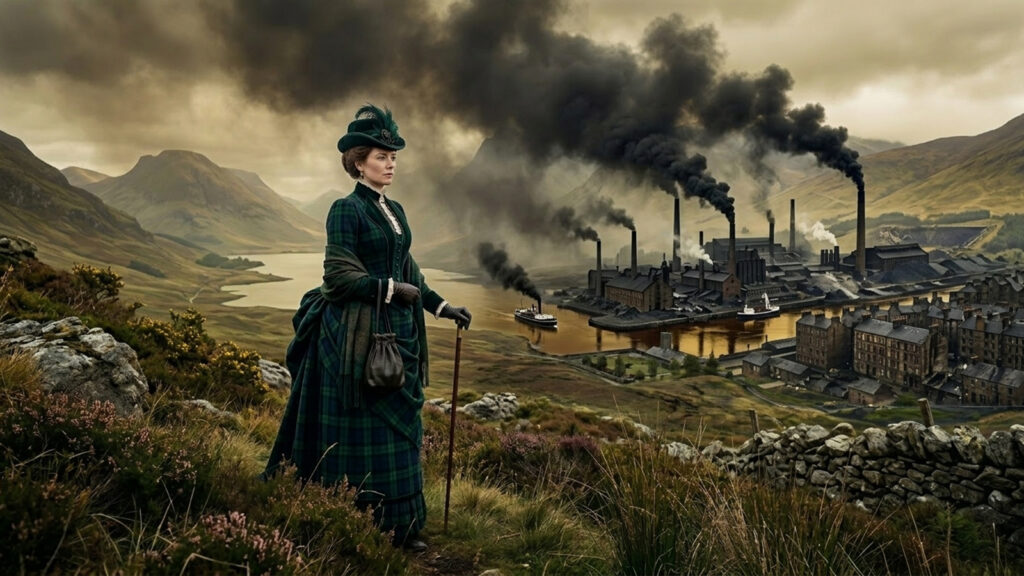
The atmosphere, darling, was coal smoke and cholera.
Here’s the thing about time-travel fantasists: they’ve watched a beautifully directed costume drama, seen a woman in a nice bonnet gazing wistfully across a moor, and built an entire fantasy around it—a fantasy that conveniently omits the fact that said woman lives in a time where enormous numbers of children never reached their fifth birthday.
The bonnet is doing a lot of heavy lifting in this fantasy.
Meanwhile, the historical novelist—who has just spent three months researching Victorian dentistry so one minor character can wince convincingly—is quietly vibrating with rage.
Because they know.
They know about the arsenic in the wallpaper.
They know about the mercury in the medicine.
They know that “consumption” wasn’t a personality trait; it was a slow, wet, horrifying death that hollowed out families with the efficiency of a Victorian factory.
They have read the primary sources. They have seen the workhouse ledgers. They have, gods help them, read firsthand accounts of amputation before anaesthesia was reliably used—and they did it on purpose, for you, so Chapter Twelve would ring true.
And you want to time travel there for the dresses.
Let’s talk about those dresses. Because I guarantee you’re picturing yourself as the woman wearing the silk gown at the ball, not the women who made the gown, dressed her, washed her linen, emptied her chamber pot, cooked her dinner, and kept the fire going.
Funny how nobody time-travels as the staff.
You’re also one infected cut away from developing a very different opinion of modern medicine. But I digress.
Now, to be fair, there were beautiful things. The architecture. The craftsmanship. The music. The letters people wrote. The extraordinary resilience of ordinary people who built lives, found joy, fell in love, raised families, and laughed anyway.
That’s why historical novelists keep returning to the past.
Not because it was kinder.
Because the people were remarkable.
The novelist isn’t being a killjoy for sport. They’re being a killjoy because they’ve done the work of sitting with the past instead of doing a costume-shop fly-by of it. They’ve had to reckon with the fact that “the good old days” is a phrase that only really works when you’re standing a very long way away from the actual days in question.
Historical novelists live in the compost heap of history so the rest of us don’t have to. They turn over every rotten, fascinating, occasionally foul-smelling layer of it, searching for the stories buried underneath.
All they ask in return is this: Please don’t tell them it sounds cosy.
So the next time you find yourself dreamily musing about tea and bonnets and misty highland romance, maybe just picture the novelist across the table, holding a very large teapot, and doing long, slow breathing exercises.
They’re not judging your love of history. They’re just hoping, very quietly, that one day we’ll stop mistaking a costume drama for the past.
Wear the bonnet.
Buy the book.
But maybe don’t book the one-way ticket.
—————————————————————————
Down the Rabbit Hole
Books and links
This Rabbit Hole is a little broader than usual. These are the tabs that stay open and the books that never quite make it back to the bookshelf. Enter at your own risk; some of them have cost me entire days. — AEF
Irene Maver, Glasgow (Edinburgh University Press, part of the Making of Scotland series) — Probably the best single-volume history of the city, with substantial Victorian-era coverage of municipal government, housing, the “civic gospel,” and public health.
C. A. Oakley, The Second City — A classic, more narrative and anecdotal history of Glasgow’s rise. Very readable.
Glasgow City Archives ↗ — Glasgow Life, the serious archival motherlode.
The Glasgow Story ↗ — Glasgow Life, a wonderfully accessible way into people, places, objects and the city’s history.
Virtual Mitchell ↗ —Glasgow Life photographs, photographs, photographs.
Scottish Corpus of Texts & Speech ↗ — University of Glasgow School of Critical Studies, a truly magnificent resource.
NLS Post Office Directories ↗ — National Library of Scotland, absolute historical-novelist crack. Who lived there? What businesses were on that street? What was next door?
University of Glasgow Archives & Special Collections ↗ — deeper dive when you’ve developed a Question That Has Become A Problem.
Scottish Maritime Museum ↗ — because industrial and working Scotland matters enormously to the world you’re interested in, and because it’s another corrective to Scotland-as-one-enormous-moor.
John F. McCaffrey ↗ — JSTOR, scholarship I keep coming back to