
GALLOWGATE
Read the Opening
The following pages are taken from the opening of Gallowgate.
I hope you enjoy them.
—————————————————————————
A knock came—light, uncertain. Not the knock of men bearing weight.
Sister Agnes noticed the pen still between her fingers. The ledger lay open before her, the page waiting, as though the knock might not be for her.
The crucifix above the door caught what little morning light there was, dark wood against limewash. Beyond the wall, the close—the narrow court between the buildings—had already begun its daily protests. Voices carried too easily through thin stone, a cart wheel struck hard against the cobbles, and the day announced itself whether it was wanted or not.
Another knock. No firmer than the first.
She set the pen aside and crossed to the receiving door.
A young porter stood on the threshold, cap in his hands, the dust of the street still clinging to his boots. He did not step inside. “They’ve been asking, so I was sent here.” He swallowed. “Schoolteacher. Mairi Dow.”
Agnes wiped her hands on her apron. “Has she passed?”
The porter hesitated. “No one’s said so.”
Agnes’s fingers lingered against the cloth longer than needed. “Then she is not ours,” she said gently.
“She teaches the wee ones,” he went on, hoping it might change the rules. “She’s twenty,” he said quickly. “Always early. Never misses.”
She considered his words a moment. “Then let us hope she continues not to,” Agnes said.
He lingered a second longer than courtesy required. “She’s the sort you’d notice gone,” he said, adjusting the grip on his hat.
Agnes held his gaze. “Yes,” she said. “Sometimes.”
He gave a short nod and left. Agnes watched him go. Missing was a word the living used with restraint.
Sometimes it merely meant late.
She opened the doors wide behind him and returned to the waiting ledger. The book was heavier than the number of its pages would suggest. Agnes felt it each morning when she lifted it from the shelf—the weight of names, dates, and final places, each entered in the same precise hand. It held not only the dead of Gallowgate, but the overflow of others—those brought down from the wynds and closes where there was no space left to keep them. She returned to the table, and took up the pen once more.
She looked at the blank line. Not every name came when called. Not at once.
7 October
1853 Ceana Fraser
aged 72.
The morning was properly underway now. A wagon rattled past the gate. Something scraped across the cobbles. In the reception room, Sister Martha sorted papers into neat stacks, the drawer opening and closing with its familiar squabble.
Agnes sanded the ink and closed the ledger. The receiving doors stood open to the morning air. Vinegar waited in the basin beside the slab.
The yard resumed its noise as though it had never been disturbed. The shuffling of boots and a firmer knock followed soon after. This time it was the proper one.
Martha came in from the reception room as the porters brought Ceana Fraser in on a board stretcher. The smell reached them before the body did; sweet, thick, unmistakable. The kind that travelled fast in rooms where too many lived too close, where a door shut too long became its own warning.
Agnes motioned towards the House. “Shut the inner door.” A Novice Sister, Mary-Anne, who had been hovering at the threshold, turned quickly and obeyed.
“Windows,” Martha said, already moving toward the reception room. A woman in a shawl stood there, clutching a small wrapped parcel to her chest.
Mary-Anne had not moved from the doorway, her back pressed against the wood of the door.
Agnes glanced at her. “Come in, Sister. Have you tended the dead before?”
“Just at home. I helped my mother lay out my uncle for his wake.” She shivered in the chill of the room.
“This will feel like a cruel introduction to our work; this one will test you.” Agnes’s voice remained even. “If you feel sick or lightheaded, you may leave—but you must eventually come back.” She attempted a smile. She wasn’t sure if it helped.
Mary-Anne swallowed and stepped fully inside.
Ceana Fraser lay curled upon herself, the body stiffened in the posture in which it had finished. Her knees were drawn up under her, the marks of her floorboards pressed into her shins, the grain of the wood left there. Her rosary was woven through the fingers of her clasped hands, the beads worn smooth with use. Agnes felt a small, private satisfaction at that. It spoke of a life kept in order.
“We’ll have to ease her,” Agnes said quietly. “The joints will try to dissuade us.”
Martha returned and set the parcel on a shelf. “The neighbour brought Mrs Fraser a change of clothes.”
“Thank you, Sister.” Agnes glanced at Martha and returned to her work. “We’ll start with cleaning and try to persuade her body to relax. We must work slowly, tenderly.” She looked up at Mary-Anne, pale and trying not to look frightened. “It’s alright to step out. There’s no shame.”
Mary-Anne nodded, stepped out the receiving doors, retched, and gulped at the fresh air.
Agnes did not touch Ceana Fraser’s body at first. She studied it before deciding to begin with the hands. The fingers were fixed hard around the beads; it took steady pressure to free them. When they opened, the skin bore the small crescents the rosary had pressed there. Working deliberately, she unwound the rosary and set it beside the folded dress.
Only then did she turn to the arms and knees. Ceana’s limbs straightened by degrees. The work required persuasion more than force, but the joints eventually yielded, with the stiff complaint of tendons long held in one position. Fabric tugged where it had dried.
Agnes began washing the old woman’s body. There was no urgency.
Mary-Anne stepped back inside and stood close to the bowl of vinegar. “She sewed,” she said, surprised at herself. “Her fingers.”
“Yes,” Agnes said. “And laundry.”
“How can you tell?”
Agnes slid the cleaning cloth beneath the body. “The skin remembers,” she said. “Even when no one else does.”
They worked at a steady pace. Mary-Anne turned pale again but did not leave. Agnes passed her a small rag soaked with vinegar. “Hold it under your nose. It helps.”
They dressed Ceana’s body for the last time. “That will do,” Agnes said softly, as they fastened the small buttons of the dress.
Mary-Anne fumbled with one. “It doesn’t matter if she can’t feel it.”
Agnes adjusted the collar. “It matters because we can. That is the difference.” And because no one had, once.
They brushed Ceana’s hair until it lay smooth against her scalp, fine as thread.
When they were finished, Ceana Fraser lay straight and composed, the strain eased from her face.
Mary-Anne stepped back. “Is she ready?”
Agnes adjusted the collar once more with the same care she had given the first time. Then she settled the rosary back into the woman’s hands. “Yes,” she said. “She is ready. Please go and fetch Dougal.”
The receiving doors opened again, and more cold air moved through the room. Martha returned to the reception room, tying the lavender sprig back around the folded paper that bore Ceana Fraser’s name. The scent did not disguise anything; it simply insisted on itself.
Dougal appeared at the door with a small pine box. It was plain, unplaned in places, the grain raised where damp had touched it.
No one spoke.
Dougal and Agnes lifted first, then Martha guided the shoulders. Ceana’s weight had lessened in death. The box received her without ceremony. Agnes tucked the rosary once more between her hands, tightening the fingers around the beads so they would not shift when the lid was set.
The nails were small. Dougal tapped them in with even strikes. Not hurried. Not lingering.
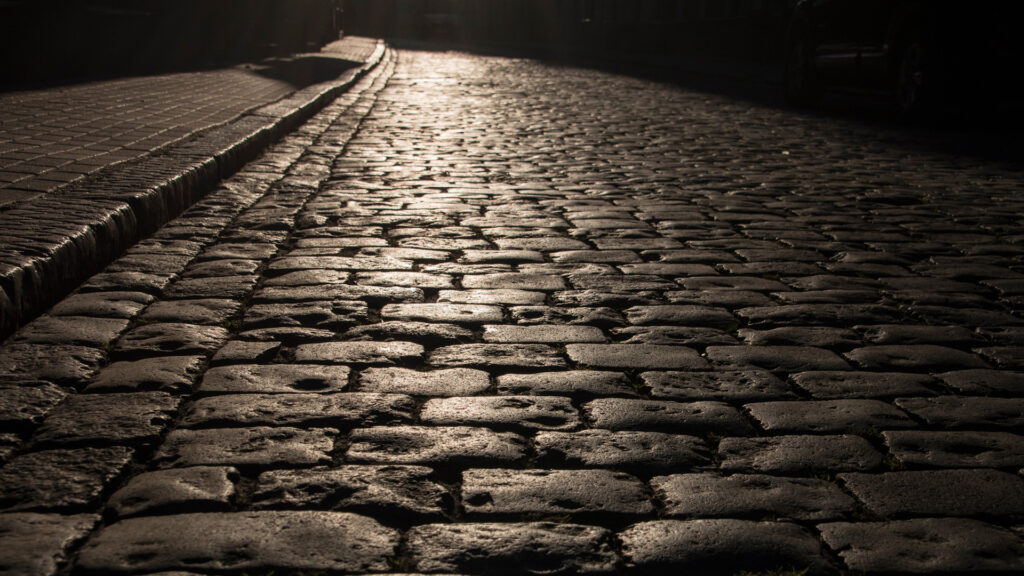
Outside, the yard had begun to inch toward midmorning. The cobbles held the sheen of water but no shine. At the far end, where the earth had been turned before, the soil lay darker than the rest.
The pine box was loaded into the barrow, and Dougal wheeled it towards the gates.
When they returned to the reception room, Agnes washed her hands again. Incense lit. Vinegar refilled. Cloths wrung out and folded. The slab was wiped clean and left bare, the stone holding its cold. The ledger was noted, closed, and returned to its shelf.
By the time the bell marked the hour, there was no sign that Ceana Fraser had been there at all.
The story continues in Gallowgate
© A. E. Fenwick
This excerpt is provided for personal reading only.
Please do not reproduce or distribute without permission.